
What the Sequence Knows
On sequencing, editing, and the arc that holds a story together

I almost didn’t go.
I had photographed the Mariamman festival the previous year and hadn’t enjoyed the experience. Not because it wasn’t visually rich — it was. But the ritual involves a great deal of piercing, and I found myself deeply uncomfortable shooting it. There is a difference between bearing witness to something and pointing a camera at it, and I hadn’t resolved that difference for myself.
The Mariamman festival runs across Mumbai for nearly three weeks, from mid-April through the first week of May. Celebrations happen in neighborhoods all over the city — one after another, overlapping, each with its own community and character. This year, I had skipped every single one.
Then my friend Suresh Naganathan — photographer, workshop mentor, someone whose eye I trust — told me about a specific celebration at Cheeta Camp in Trombay. One of the last of the season, falling on May 1st, a public holiday in Mumbai. He said this one was different. That there was an extended preparation beforehand, a whole world before the procession began, and that I would respond to it. He convinced me to go.
I am glad he did. I came back with close to 500 frames. And then the harder work began.
This post is about that work — not the shooting, but the editing. How you look at a large set of images and decide what stays, what goes, and in what order.
The first cull: from 500 to 24
The initial pass through 500 frames is less about selection and more about elimination — obvious failures, missed focus, frames where nothing resolved. Set them aside without sentiment.
What remains after that pass still tends to be too many. The second cull is harder because now you are choosing between images that all work to some degree. This is where your instincts about the story start to matter more than technical assessment.
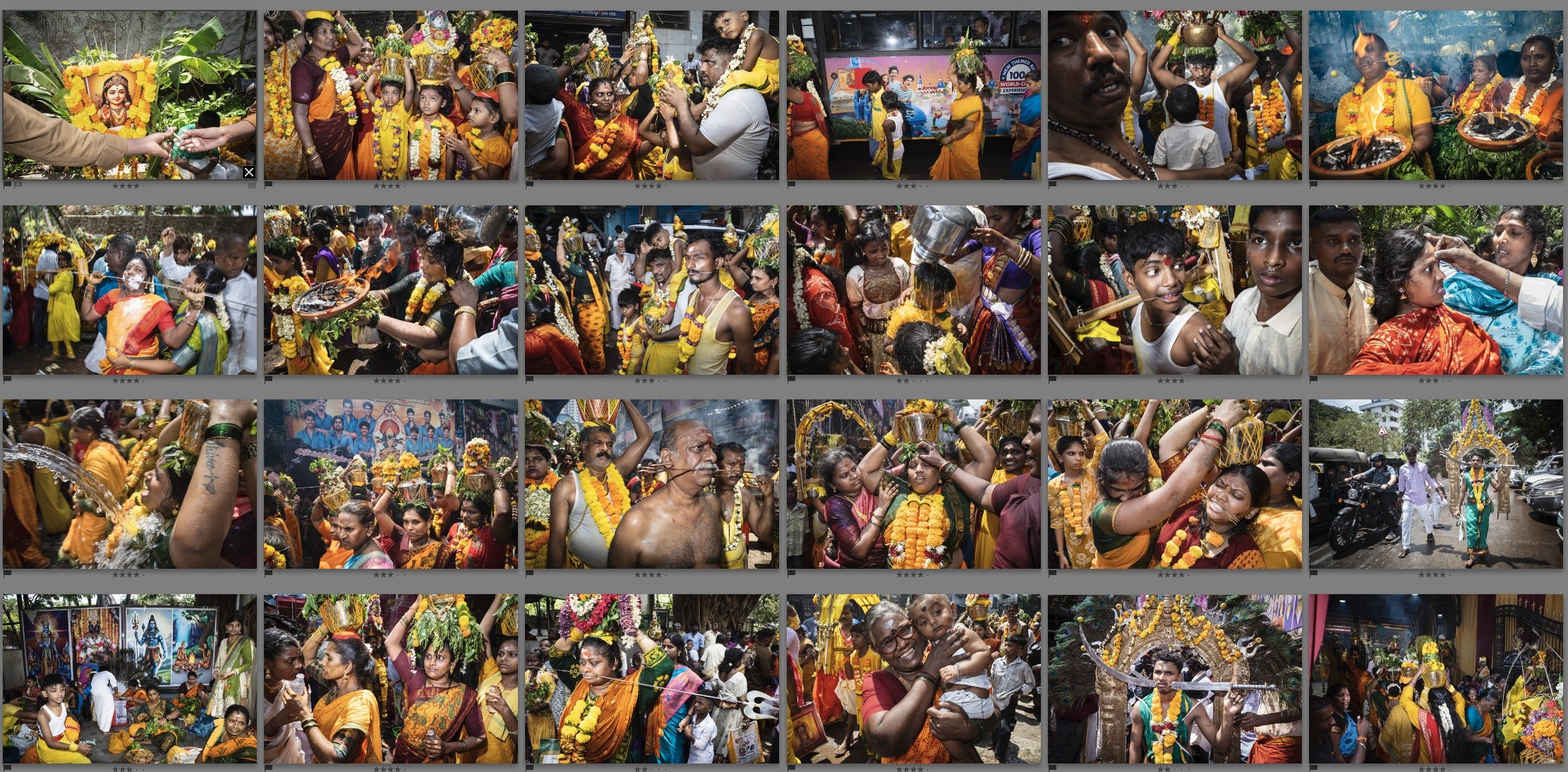
I came down to just over 20 images that I felt could collectively tell the story of the day. You can see them in the Lightroom screenshot below — the starting point before the sequencing work began.
Starting with a feeling, not a formula
David Alan Harvey has a line I return to often, both while shooting and while editing:
“Don’t shoot what it looks like, shoot what it feels like.”
It applies equally to sequencing. The question I asked before placing a single image was not what I wanted to show, but what I wanted the viewer to feel moving through the photographs.
The answer came quickly: begin slowly, peak in the middle, end slowly. A breath in, a full intensity, a breath out. The festival itself moves that way — devotion begins in quiet preparation, rises into something that defies ordinary experience, and then the body slowly returns to itself.
That emotional shape became the spine. Every editorial decision came back to it.
One more thing shaped my approach: I had stayed away from shooting the actual piercings at close range. That discomfort was real and I chose to honor it. What I had instead were the before, the during, and the after — preparation, procession, trance. In some ways that constraint made the sequence more interesting. The essay moves around the intensity rather than into it.
The choices that required the most thought
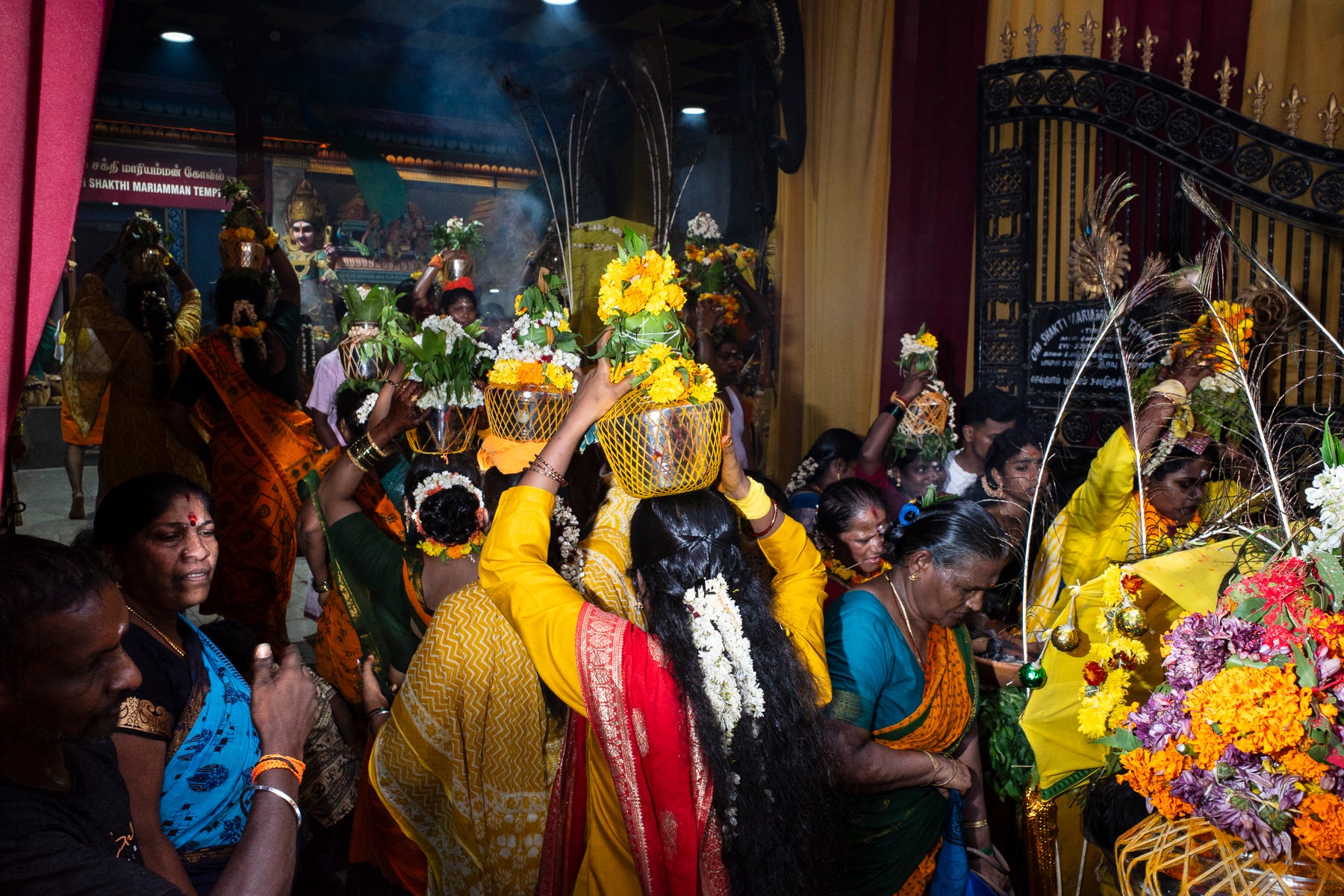
The temple interior. Early in the edit I had included an interior shot of the Shakthi Mariamman Temple — the signage visible, the space filled with worshippers. I included it for a practical reason: it grounded the geography, gave the viewer a sense of place. It was also one of my favorite images from inside the temple. But when I looked at it honestly within the sequence, it was the weakest image compositionally — dark, cluttered, people’s backs to the camera. The preparation image at the very beginning was already doing the work of location and context, and doing it with far more warmth and story. Two images cannot occupy the same role in a sequence. The temple image was cut. It will find a better home in a different context — perhaps accompanying a written piece about the festival itself.
Two images of the sacred in traffic. I had two photographs of the procession moving through the streets — a kavadi bearer walking past motorcycles and cars, and pilgrims passing a city bus carrying an amusement park poster. Both placed the sacred inside the everyday. But the bus image does something the traffic image doesn’t: those smiling, carefree faces on the advertisement create an active counterpoint. The contrast isn’t just visual — it’s tonal. Ordinary happiness set against extraordinary devotion, side by side on a Mumbai street. The kavadi bearer in traffic is a strong image, but the city around him is simply neutral. The bus gives you something to feel the gap between.


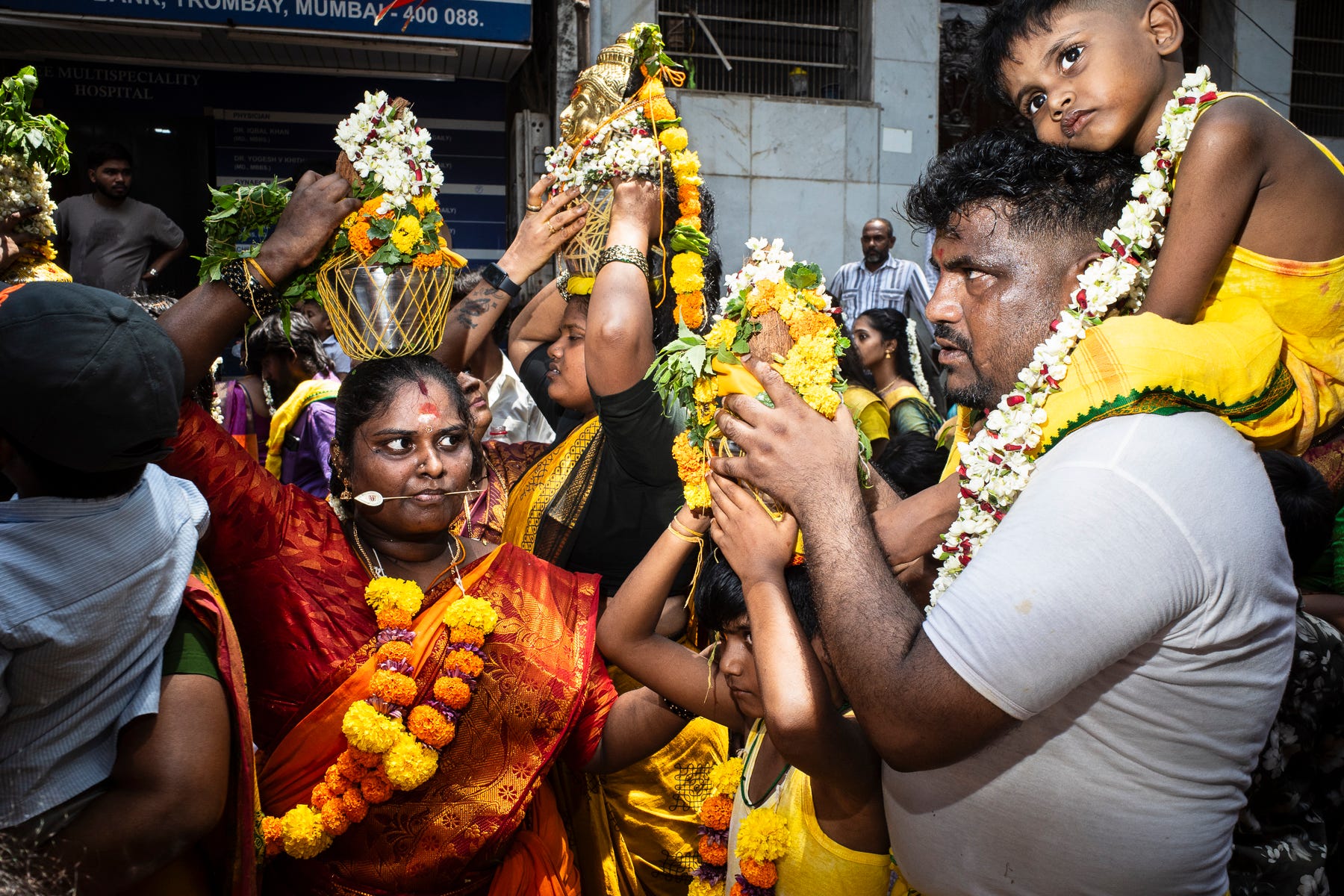
The boy on his father’s shoulders. This was the hardest cut. One of my favorite images from the day — a father carrying his young child on his shoulders, the child looking out over the procession with wide eyes. The layering of generations, tenderness held inside intensity — it felt important. But the image I placed instead, the dense crowd with the young man’s direct gaze over his offering pot, was compositionally cleaner and flowed better into its neighbors. The father-and-child image disrupted the sequence at the point where it needed to be building inward. I couldn’t find a place for it that didn’t cost something elsewhere. It remains one of my favorite photographs from the day — just not from this essay.
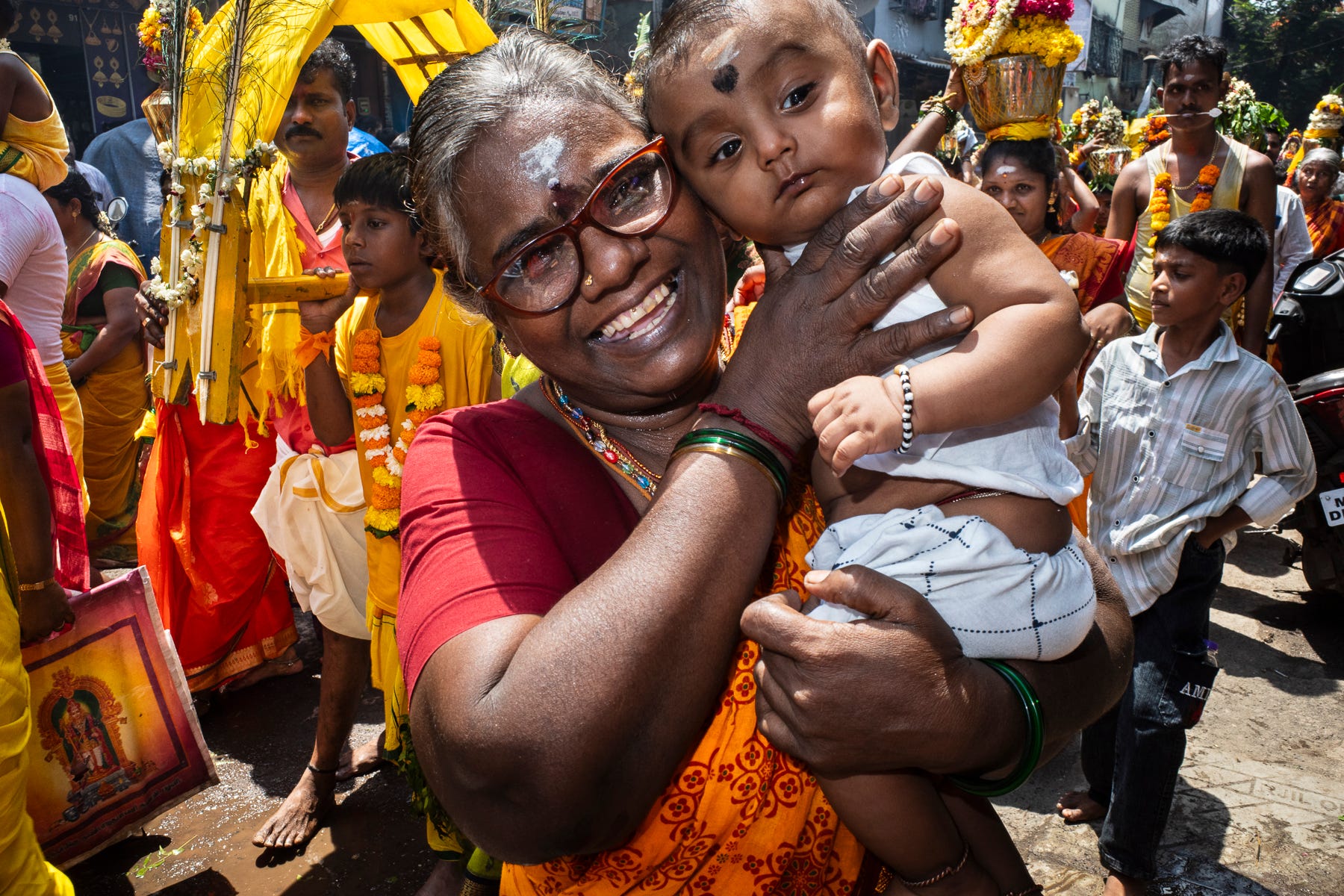
The grandmother and baby. I had originally planned to close with this — a grandmother holding a baby, beaming. Beautiful photograph. But the rest of the sequence lives inside the experience of devotion, bodies under it and returning from it. The grandmother and baby exist outside that world entirely. Ending there felt like stepping out of the room rather than settling into it. The stronger close was the woman in trance being steadied by hands around her — community as care, the body held after surrender. That is a complete thought. The grandmother photograph will find its place elsewhere.
The boy between the two water images. A late placement decision that worked. The two water images are both high-energy, and placing them directly together created a wall with nowhere for the eye to rest. The boy — that sideways glance, the faint curiosity in it — becomes a breath between them. And the direction of his gaze pulls you naturally into the cascade that follows.
The final 12
Substack limits galleries to nine images, so the sequence is split across two. The last image in the first gallery — the boy glancing sideways — was placed there deliberately. His gaze carries you across into the second.


What this edit taught me
Sequencing is not arrangement. It is argument. Every image makes a claim on the viewer’s attention, and you are responsible for what they encounter before and after it. A strong image in the wrong position can break a sequence. A modest image in the right position can do essential work.
Coming back to Harvey’s words — shoot what it feels like — the same is true of editing. The sequence that works is not the one where every image is technically the strongest. It is the one where the feeling carries, unbroken, from the first frame to the last.
The images I was most attached to were not always the ones that served that feeling. Letting go of the father-and-child image was genuinely difficult. So was the grandmother. So was the temple. But the essay became more itself without them.
And starting with the preparation scene — which I had almost left out of the initial set entirely — turned out to be one of the important decisions I made. The whole sequence earned its intensity because it had a quiet beginning.
I almost didn’t come to this festival. I am glad Suresh pushed me. The day gave me more than I expected — not in spite of my discomfort, but partly because of it. The edit reflects that. It is a sequence about devotion seen from a respectful distance, moving around the edges of something it cannot fully enter.
The festival is over. The images remain. This is how I decided what they mean together.
All photographs from the Mariamman festival, Cheeta Camp, Trombay, Mumbai.
Do you think about sequencing when you edit your own work, or do you tend to present images individually? Leave a comment below.
Thank you so much dear Uday for this fantabulous detailed explanation and write up. It's a big lesson for all of us. I will keep coming back to this one, to learn, unlearn and relearn. 👍🏼👌🏼🧿🧿🤗🤩🤩🙌🏼😇💕🙏🏼👍🏼
Interesting documentation Uday! Thanks for sharing the process